
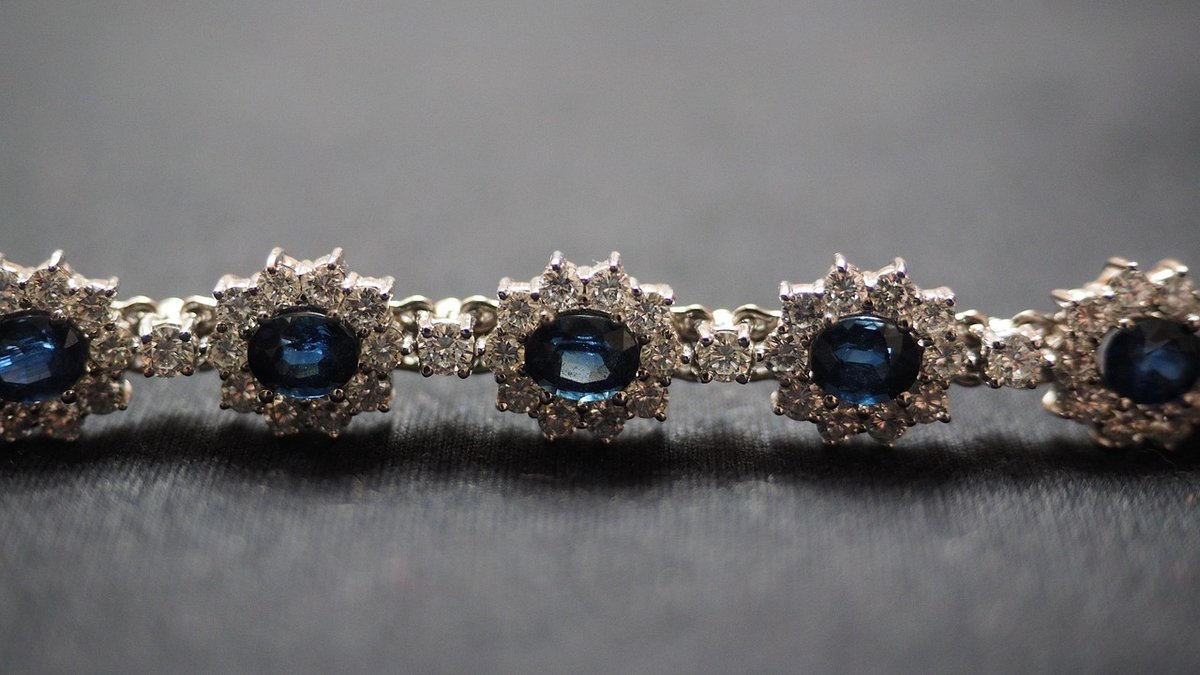
A natural gemstone is a mineral that formed in the Earth without any human intervention. Diamonds crystallise roughly 150 to 200 kilometres below the surface, where temperatures exceed 1,000°C, and are later carried upward by rare volcanic eruptions. Sapphires and rubies grow in metamorphic rock, reshaped by heat and pressure over hundreds of millions of years. Emeralds form where beryllium-rich fluids meet chromium-bearing rock — a geological coincidence that makes fine emeralds genuinely scarce.
That long, slow formation leaves its mark. Natural stones almost always contain inclusions — tiny crystals, feathers, or growth lines trapped as the gem grew. Far from being flaws, these are the fingerprints of a stone's origin. A ruby with fine silk rutile needles, or a sapphire with a soft colour zoning, is telling you something about where it came from. Trace elements are responsible for colour itself: chromium gives ruby its red, iron and titanium give sapphire its blue.
Lab-grown gemstones have the same chemical composition, crystal structure and optical properties as their natural counterparts. The difference is the timeline and the setting. Rather than centuries underground, they're grown in weeks using controlled processes.
Because the environment is controlled, lab-grown stones tend to be cleaner, with fewer inclusions and more consistent colour. A gemmologist using standard magnification can usually identify them by distinctive growth patterns, but to the naked eye — and to the wearer — they look like the real thing.
If the chemistry is identical, what are you actually paying for? Four things, mainly.
An honest jeweller will always tell you which you're looking at. If you're unsure, ask for the stone's origin in writing.
Durability is where the two categories are closest — because they're the same material. Diamond sits at 10 on the Mohs scale whatever its origin. Sapphire and ruby reach 9. Emerald sits at 7.5 to 8, and its natural inclusions make it more prone to chipping, which is why emerald rings deserve a protective setting and a little care.
Interestingly, a lab-grown emerald with fewer internal fractures can sometimes be the more robust choice for daily wear. On the other hand, some lab-grown diamonds receive treatments to improve colour, so always ask. For cleaning, stick to warm water with a drop of washing-up liquid and a soft brush for diamonds, sapphires and rubies. Keep emeralds, opals and pearls away from ultrasonic cleaners and steam — they don't appreciate the shock.
Natural stones reward a slightly more considered approach. Their inclusions and subtle colour variation give pieces a warmth and depth that photographs poorly and wears beautifully. Set a softly included emerald in recycled yellow gold with a milgrain edge and you have something that looks inherited rather than bought. A parti-coloured sapphire works wonderfully as a single statement stone on a plain band; a ruby with visible silk looks richer in a rose gold bezel, where the metal's warmth lifts the red.
Because each stone is unique, natural gems suit one-off commissions and heirloom-style designs. Consider a bezel or rub-over setting for anything worn daily — it protects the girdle and softens the silhouette. Stack natural gemstone rings in mixed metals rather than matching them perfectly; the slight irregularity is the point.
Lab-grown stones come into their own when you want scale, symmetry or sheer sparkle without the price tag. A three-carat lab-grown diamond solitaire that would be unthinkable in natural stone becomes achievable, and it looks magnificent in platinum or white gold with a slim, modern band. Matching pairs are far easier to source, which makes lab-grown gems ideal for stud earrings, tennis bracelets and symmetrical trilogy rings.
They're also a sensible choice for travel jewellery, for pieces you'll wear to the gym or the beach, and for anyone building a wardrobe of bold colour — a lab-grown blue sapphire pendant in brushed silver, or a pair of lab-grown emerald drops with a simple silk shirt.
Whichever you choose, buy the stone that makes you want to wear it. Ask about treatments, ask about origin, and set a budget you're comfortable with. Both natural and lab-grown gemstones can be beautiful, durable and utterly worth owning — they simply tell different stories.

Hi, my name is Anthony kuber. I am artist and fashion designer.
I love to travel and writing blogging.
Your email address will not be published. Required fields are marked *
Software Developer & Writer
Hey, I'm Diva, a developer and writer blending code and creativity. I'm driven by a deep curiosity and a relentless pursuit of excellence. Join me as I craft digital solutions and captivating stories.


